NieR: Automata is hack and slash, open world, narrative-based game that was developed by Platinum Games (Metal Gear Rising Revengeance, Bayonetta, Vanquish), directed by Yoko Taro, co-developed by Taro’s team, and published by Square Enix as a spinoff of the Drakengard series for PS4 and Windows. NieR Automata is also a follow-up to NieR, the game that killed Cavia (the […]
NieR: Automata is hack and slash, open world, narrative-based game that was developed by Platinum Games (Metal Gear Rising Revengeance, Bayonetta, Vanquish), directed by Yoko Taro, co-developed by Taro’s team, and published by Square Enix as a spinoff of the Drakengard series for PS4 and Windows.
NieR Automata is also a follow-up to NieR, the game that killed Cavia (the team behind Drakengard and Nier) due to negative reception to the combat, and low sales. Nier is a game I had not played let alone heard of before buying NieR Automata. I just bought it because it was Platinum and had played the demo. So basically, I went into this game blind. Which is honestly how I recommend you go into Automata as well, so please, do yourself a favor and skip this review for now. This game’s worth waiting for.
(Mild Spoilers)
Premise:
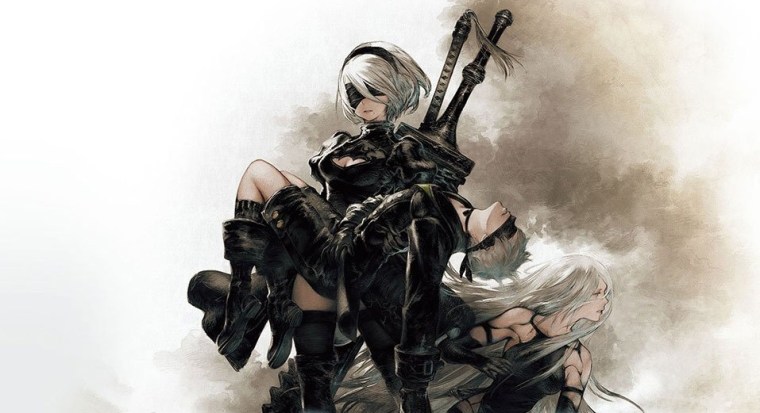
NieR Automata is about a post-apocalyptic future in which aliens have driven humans off of Earth and onto the moon, and have deployed various machine life forms to be their army of sorts. That’s where humanity’s army-YoRHa-comes in. YoRHa is an army of androids with the goal of preserving and restoring human culture and the very idea of what it means to be human.
In case you didn’t know, Automata’s story is structured a bit like Sonic ‘06 which sounds bad but it actually works for this game. There are three different campaigns in this game. Within the first you play as 2B, an obedient YoRHa android on a mission to kill the machine lifeforms and reclaim Earth, in the second you play as 2B’s scanner companion 9S, this playthrough follows the same sequence of events as the first but it reveals some crucial story aspects and has a few more cutscenes that help add some clarity, and in the third you play as A2 and 9S in an entirely different campaign than the others that serves as a second half of the game. Because of this structure, Automata’s story is like a puzzle, with more pieces of the puzzle being given to the player each time they play the game.
During the first playthrough, the game is pretty simple. It’s a story about killing robots and aliens as androids and it just seems fairly weird, the pacing and entertainment value is still there, and it’s a good way to guide the gameplay along, but it ends on a note that leaves many questions unanswered. The second playthrough answers some of these questions and gives the events within the first playthrough more meaning and depth. The third resolves the plot and adds more characterization.
I think found the game’s story to be beautiful after completing all three playthroughs. The ideologies that it explores, existentialism, artificial life, loyalty. The intended message of the game is meant to answer many lifelong questions that humanity has raised about the very idea of being alive. In the end, the story emotionally connected to and gave answers to questions I myself didn’t know the answer to prior to playing the game. This message gave meaning to the game for me and no real game has passed the entrainment threshold into a meaningful commentary for me in years.
I love the characters in this game as well. Each of them has a distinct personality, reasonable motivation, and an interesting backstory. 2B is distant and cold for most of the time, but when it comes to losing fellow soldiers she gets emotional, she lacks connection to others due to her role in the story and she was placed into a situation in the world that she doesn’t want to be in because of the state of the current world. 9S is an emotional and clever scanner whose true value is hardly understood by others, he develops throughout the full playthrough as he learns secrets and the changes really affect him mentally. A2 is given less character development and backstory than the others, but due to her being a unit that abandoned YoRHa she’s really laid back and has a tendency of impulsiveness and violence. Each of the characters fits in with the theme of the game, however.
My only problem with the story is how even though the second and third playthroughs give more answers than the first, the third playthrough’s climax is rushed, there are many essential plot twists and answers to the story that are straight-up glossed over in favor of the combat. The endings within this playthrough are around a minute long and still leave some important questions unanswered. Which is fine because it allows the player to interpret the ending, however, there still are some missing pieces of the aforementioned puzzle.
Overall, NieR Automata is a game that’s deceptively simple and Cliché if you just look at the concept and take the game at face value. However, once you take a deep dive into interpreting individual scenes or deciphering the message that Yoko Taro is trying to tell, the story becomes entirely different. NieR Automata’s story is intentionally vague and it hides its secrets behind ideologies and symbolism and because of this. It’s perfectly paced, has great characters, an intriguing universe, an important and emotionally moving message, and a great plot.
Gameplay:
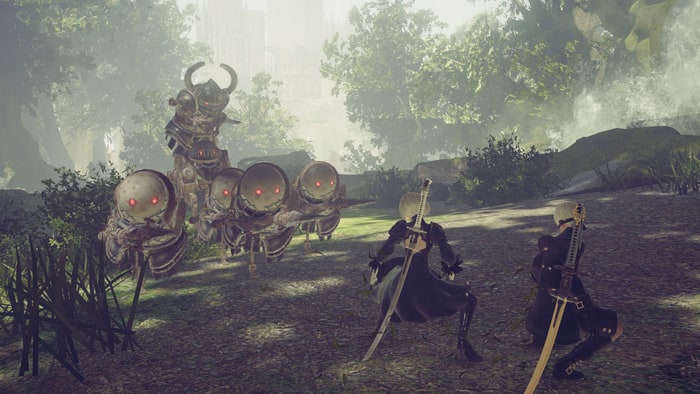
Platinum, as usual, did an amazing job with the gameplay. While it’s not necessarily ground-breaking with the core mechanics like previous platinum games such as Metal Gear Rising Revengeance with Blade Mode and Zandatsu or Vanquish with the slide attacks. Automata follows suit with Bayonetta by having a dodge mechanic which you can use as a counter of sorts which you can use in the air or on the ground. First, dodge the enemy attack then, follow up with a stronger counter attack.
In terms of ranged attacks, Automata is fairly basic as well. Press R1 to fire an array of bullets and press L1 to use a special attack. Although this is nothing special, it can be used to counter a large majority of enemy ranged attacks as well.
The attacks, for the most part, have to do with your character’s position and their weapon of choice. When starting a jump and using a heavy weapon (heavy attacks are exclusive to 2B and A2 but you can do the same with a light attack as 9S), your character can slash an enemy into the air, while fully in the air, your character can use either a variety of juggling light attacks, or a downward slash with a heavy attack. There are a number of ground and combos that have to do with mixing heavy and light weapon attacks as well. Overall, attacking as any of the characters is fairly simple and after some time you’ll find out the limit of what you can do. The main joy in the combat system comes from finding new weapons and learning the ideal loadout and combos with the weapons of the four weapon classes. Since each individual weapon in the four classes doesn’t have any unique attacks, but rather stat and cosmetic differences.
A2 and 9S also have unique gameplay mechanics specific to them. 9S has a hacking ability which gives you a shoot ’em up minigame, that if completed in a short period of time, will do a large amount of damage to enemies or allows you to assume control of them and A2’s berserk mode which will take away health gradually while giving you a MAJOR stat boost. The last gameplay mechanic of note is the flight unit mechanic which is basically a version of the regular gameplay with movement on a more restricted plain.
Although I acknowledge that the gameplay is fairly limited in terms of attacks, the gameplay never really gets boring due to the enemy variety, plug-in chip mechanic, and general difficulty. Each enemy in NieR Automata moves in ways that complement the dodging system and require you to adapt to their various techniques, especially with the boss battles which all have scale and unique challenges. The plug-in chips give you a mixture of boosts that change the gameplay in drastic ways such as giving you health for each enemy you kill, adding shock waves to your melee weapons and turning them into multi-purpose weapons, and raising stats. There are only a limited amount of these though.
I love the core action aspects of the gameplay in NieR Automata. Problems start to arise for me, however, with the open world half of the game. NieR Automata has six areas on the overworld that you revisit again and again to the point where it gets a little stale. The world is pretty empty as well with the exceptions of side quests, enemies, and settlements which are almost entirely separate. Exploring in this game is outright pointless, most of the land in the game is filler to add extra playtime for the most part. The other open world elements are well implemented though, the side quests are fun and have a satisfactory variety of objectives and a good amount of backstory unlike a majority of open world games and movement is fairly quick for the most part. I’ll also say that the story makes a good enough effort to have a non-traditionally structured story that the open world does not affect the pacing of the story or comprehension.
The last problem I have is the jarring camera angle changes. Occasionally the game is a typical hack n’ slash game on a 3D plane, another part of the type the game is a side-scroller, another portion of the game is from a top-down perspective. I understand it’s for stylistic purposes, but it feels unnecessary and it personally affected my performance at least a few times.
In the end, NieR’s gameplay isn’t the deepest or most interesting out there, but it still provides a good amount of fun and at times intensity. There’s not too much variety in the open world or in general RPG half, but there’s still plenty of content that ties into the story as well as optional content, and the gameplay changes up regularly enough that it never gets boring.
Visuals/Tech:
NieR Automata doesn’t particularly look fantastic in the graphics department, but it doesn’t look bad either. The frame rate is consistent and the animations, for the most part, are life-like. The place where the visuals in the game shine is the design. Each and every aspect of this game looks unique. The robot design is something that you won’t see in any other piece of media, the character and weapon design not only fits with the storyline but leaves an impression on you. The universe is so memorable and its identity is so distinct. I do have a problem with some of the environments though as they don’t really stand out at all and there are plenty of reused assets.
Audio:
While this game took a while to impress me in the story and gameplay departments, from the very start of the game, the soundtrack captivated me. Platinum games have some of the best soundtracks, Metal Gear Rising Revengeance has an electronic metal track that starts off slow and solely instrumental then later on as the gameplay stakes raise, a vocal version of the track comes in. NieR Automata is similar to this but with more orchestrated tracks that capture the beauty of the world. Every track perfectly encapsulates the universe and identity of NieR. I don’t have any favorite tracks because the soundtrack is so consistently good, so I 100% recommend checking it out.
Cutscenes/Direction:
NieR Automata’s cutscenes aren’t the most interesting in the direction department. Don’t get me wrong, the direction is competent and there’s enough variety in the camera techniques to keep you entertained, and each cutscene is the perfect length.
Thoughts and Rating:
NieR Automata is a fantastic game with solid gameplay, a story that for the most part is great, a soundtrack worth listening to for years to come, and great technology behind it. My only problems with the game have to do with some clear time restraints. The empty world and abundance of backtracking, the rushed climax, etc. I think the game is definitely worth its price and a 100% completion.

 Pressanybutton